Getting Here
Read more

Sat 14 and Sun 15 March, 10am - 4pm | Free, bookings required
Join us for two days of inspiring talks, presentations, and a film screening, featuring experts and enthusiasts who share personal stories about all things wooden boats, from navigation to heritage preservation and maritime history. Discover the lineup below.
New Zealand boat designer John Welsford shares the philosophy and experience behind his internationally known small-craft designs. Based in Rotorua, Welsford has spent decades creating practical sailing and rowing boats that can be built by amateurs yet are capable of serious cruising and coastal voyaging. His designs are now constructed by builders around the world, ranging from first-time hobbyists to experienced craftsmen.
Welsford’s presentation explores the principles that guide his work: simplicity of construction, efficiency under sail and oar, seaworthiness, and the enduring appeal of traditionally styled wooden boats enhanced by modern design methods.
Drawing on stories from builders and sailors who use his boats for exploration, family cruising, and long-distance adventure, Welsford reflects on how small-boat building fosters skills, independence, and community. The seminar offers both practical insights into boat design and an inspiring look at how well-designed small boats continue to open the door to meaningful experiences on the water.
Duration: 45 minutes
Join AWBF Festival Director Paul Stephanus for a whirlwind history of the Australian Wooden Boat Festival: its humble beginnings 1994, the people and places that shaped it, key turning points, and how programming, partnerships, and audiences have evolved over time. A look at growth, challenges, and what the next cycle might hold.
Duration: 45 minutes
There are about a dozen communities left on earth where people in traditional craft still rely on their sails to carry out meaningful work. They don’t do this for romantic reasons, but because they can’t afford a cheap diesel engine or the fuel to drive it. These working sailing fleets, that were originally responsible for binding humanity into a single ecological and historical system, have, almost by accident, become the last bastion of a disappearing tradition that globalised the human story.
One such community is the Dhow sailors of the East African Coast.
Mark Chew, was born in Kenya, and returns there every year working as a photographer in the refugee camps and slums of the region for development and aid agencies. He also regularly visits the Indian Ocean coast line, making friends with local sailors, sailing on their boats and trying to understand the history, construction and function of these ancient, magnificent lateen rigged craft.
Visit the “Disappearing Dhows” exhibition, it is a contemporary photographic record of the sailing craft in this part of the world, documenting their construction, their function, their culture, and the people who sail them.
Duration: 45 minutes
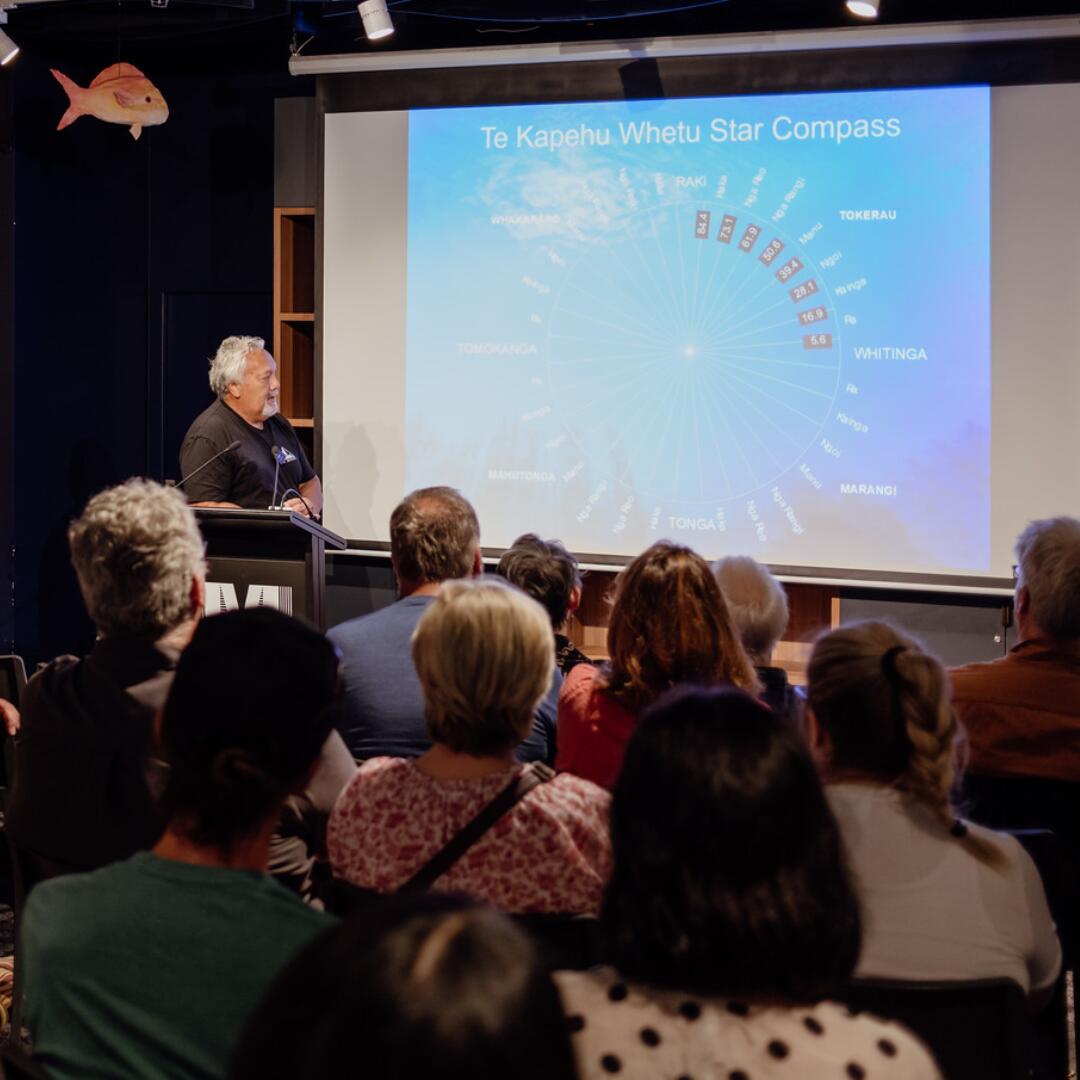
Two leaders in the revitalisation efforts of mātauranga waka hourua in Aotearoa come together to reflect on the remarkable revival of an almost lost practice. Stan Conrad, Matakura and captain of Te Aurere, the first waka hourua made in Aotearoa of the 20th century, and Hoturoa Barclay-Kerr, Matakura and founder of the Te Toki Voyaging Trust, have each played pivotal roles in restoring the practice of traditional Pacific navigation in Aotearoa.
In this panel discussion, they’ll share how the resurgence of celestial navigation and deep-sea voyaging has reshaped the identity and understanding of the Māori people in modern Aotearoa. Driven by their lived experience, the conversation traces their steady, determined efforts to re-establish waka hourua traditions and practices to our waters while sharing their vision of succession.
Duration: 75 minutes
Portrait on Sir Hekenukumai Busby, an honoured icon who went above and beyond to help reclaim the lost art of traditional Māori voyaging.
"For Māori, the canoe underpins our culture. We once built waka/canoes from giant trees and sailed the vast Pacific by the stars. These arts were lost to us for 600 years. Then the stars re-aligned and three men from far flung islands revived our place as the greatest navigators on the planet, a Hawaiian, a Micronesian and Hek Busby, “The Chief” from Aotearoa/New Zealand. Whetū Mārama – Bright Star is the story of Sir Hekenukumai Ngaiwi Puhipi, aka Hek Busby, and his significance for Māori in rekindling their wayfinding DNA and for all New Zealanders in reclaiming our place as traditional star voyages on the world map."
Duration: 90 minutes
The 1950’s were exciting and prosperous years in New Zealand. As part of the post-War revival the Royal New Yacht Squadron sponsored a world-wide design competition for a fast and good-looking racer-cruiser, about 40 feet in length. The K Class was born with Bob Stewart’s Helen being its first member.
Having sailed since the 1930’s, well-known yachtsman Jim Faire decided in 1956 to build a K Class yacht. At that time the ‘K’s’ were the so-called ‘glamour class’ on the Waitemata. Come along and hear Peter and family share stories about the Percy Vos built, K-Class - Katrina II.
Duration: 45 minutes
Hear from two stalwarts of the steam boat community:
Steam Ferry Toroa
Built in 1925 at George Niccol’s St Mary’s Bay yard, *Toroa* is the last surviving double-ended steam ferry from the once-busy Waitematā Harbour fleet. For more than fifty years she carried millions of passengers, mainly between Auckland and Devonport, before retiring in 1980. Today, the Toroa Preservation Society is restoring the vessel to authentic, seaworthy condition, carefully rebuilding her composite hull while preserving her original Scottish-built boiler and triple-expansion steam engine. When restoration is complete, *Toroa* will return to the harbour as a living heritage ferry, celebrating the vital role steam ferries played in Auckland’s maritime and transport history.
SS William C. Daldy (1935)
Built in Dunedin in 1935, the steam tug *William C. Daldy* served the Auckland Harbour Board for decades, towing ships, barges, and assisting vessels across the Waitematā Harbour. Named after early Auckland leader William C. Daldy, the tug is today one of the last operational coal-fired steam tugs in the world. Carefully restored and maintained by dedicated volunteers, she remains a living example of traditional marine engineering. When steaming, her distinctive funnel plume and rhythmic engines offer a rare glimpse into the working harbour life that once powered New Zealand’s ports.
Duration: 45 minutes
Join us for a special session with Lin Pardey (born 1944), who sailed with her husband, Larry Pardey (1939-2020) for over 40 years covering more than 200,000nm together. As writers, known for their small boat engine-free sailing, they coined the phrase, "Go Small, Go Simple, but Go Now!
Lin continues to voyage and adventure with David Haigh. During their 2024 voyage, she completed and published her latest book: Passages: Cape Horn and Beyond. This release marks the 7th instalment in her celebrated cruising narrative series and the 13th book of her career.
Duration: 45 minutes
Kate’s talk will be about her experience as a young woman with no boat building experience and a limited budget in restoring the Bay Belle. Hey journey involved utilising resources around her - volunteers, friends and kind strangers who reached out through social media to collectively succeed in giving Bay Belle a new lease on life, with all the learnings and challenges that they experienced along the way.
Duration: 45 minutes
Join sailor and musician Nick Atkinson as he recounts an unlikely journey that began at a bakery on Ponsonby Road and wound up with our hero living on the heavily glaciated island of South Georgia with Tim and Pauline Carr. He didn't travel in a straight line however. Grand classic yacht regattas in Scotland, Sardinia, and Antigua formed stepping stones to eventually landing the gig at the museum in Grytviken, the site of an old whaling station and Shakleton's grave. Hear accounts of epic ocean passages aboard the three masted 1902 schooner Shenandoah as well as tales from three incredible seasons racing the 95' LOD 1911 Fife gaff cutter Mariquita, leavened with stints on canting keel maxis and the odd bicycle. He also never travelled without his saxophone, a tradition he continues to this day.
Duration: 45 minutes
With Dr Kurt Bennert, Maritime Archaeologist. As an island nation, Aotearoa New Zealand’s history and identity are inseparable from the sea. This presentation draws on his own experiences in maritime archaeology to explore how submerged sites, vessels, and coastal landscapes illuminate the stories of navigation, trade, industry, and everyday life. Through selected case studies from around New Zealand, he will highlight the diversity and significance of our maritime archaeological record and the challenges and rewards of researching and protecting it. The talk will conclude by celebrating the broader successes of the Auckland Wooden Boat Festival as a living expression of maritime heritage—one that connects past and present through craft, knowledge, and community. In closing this weekend of discussions on maritime heritage and navigating the past, present and future, he reflects on why recognising, valuing, and actively celebrating our maritime heritage remains essential to understanding who we are and where we are going.
Duration: 45 minutes